
Tuesday, January 28, 2014
Get Work In: Last Chance!
This period is the absolute last time I will be accepting any work from 1st Semester. If you are missing anything, PLEASE get it turned in. If anything in the grade book is incorrect, let me know right now.

Friday, January 17, 2014
Looking at College
Today we're going to begin looking at college requirements. Since we are lucky enough to have two California Community College campuses in our area, we'll focus on those to begin with.
- The Mendocino College web site has a direct link to the "College Catalog" -- the list of classes that are taught, the requirements to get a degree, and the types of degrees they offer. It can be found here: http://www.mendocino.edu/tc/pg/6286/catalog_2012_2013.html
- The college catalog also details AA/AS requirements as well as "credit transfer" requirements (http://www.mendocino.edu/docs/catalog/2012_Catalog_Pages_1-46.pdf)
- One link lists the AA/AS Degree's and Certificates offered by Mendocino College, although I strongly suggest working through your General Education stuff first (particularly your Math) while it's still fresh.
- Next we can look and see which classes are offered at Mendocino College in the Lake Center [schedule of classes].
Thursday, January 16, 2014
Scholarship Essays
 Reminder, your scholarship essays are due tomorrow. There should be 5 small single-topic essays and today's general essay.
Which brings us to today's assignment: In addition to the short essay questions, I also want you to write a general "scholarship essay" which blends together your short essays into a general "why you should pick me" essay. Imagine that you find a scholarship online and realize the deadline to submit it is today -- so you go and grab your "general scholarship" essay and simply modify it to fit the specific requirements.
It should include things such as:
- Financial Need
- Life Achievements
- Life Experiences
- Career and/or Education Goals
- Community Service
Remember to watch your spelling, punctuation, and grammar. Little things make a difference in a scholarship essay. If it's between you and another applicant and you write "collage" instead of "college" (for example), that may be enough to tip the balance.
This essay should be a full essay -- perhaps a page or two.
This essay should be a full essay -- perhaps a page or two.
Wednesday, January 15, 2014
Writing Scholarship Essays
 When you start researching scholarship opportunities, you will quickly find out that many of the scholarship programs for which you qualify involve writing a scholarship worthy essay. Very few programs are based strictly on an application form or transcript. Scholarship committees like essays because they are able to get a better sense of who the applicants really are from reading their original writing than from simply looking at a form or seeing a listing of completed classes and grades.
 When you are faced with the challenge of scholarship essay writing, remind yourself that the effort you put into writing your essay represents the chance to sell yourself to the scholarship committee. A winning scholarship essay is one that truly sets a particular applicant apart from the others. If you tell your story clearly and persuasively, you just might find yourself receiving a congratulatory letter from the scholarship committee!
Tips for Writing Effective Scholarship Essays:
- Read the instructions and make sure you understand them before you start writing.
- Think about what you are going to write and organize your thoughts before you start writing.
- Begin the writing process by writing an outline.
- Make sure your outline touches on every aspect required per the instructions.
- Write your essay by elaborating on each of the points in your outline.
- Use clear, concise and simple language throughout the essay.
- State your accomplishments without coming across as if you are bragging.
- Make sure your grammar and spelling are impeccable.
- Read the question again and then read your essay to be certain that the essay addresses every point.
- Have someone with strong writing and editing skills proofread the essay before you submit it.
- It’s better to be too long than too short. You can always edit down the material you find to be least relevant, but it is much more difficult to add to an essay that is too short.
- Talk to teachers, counselors, and admissions officers and have them read your sample scholarship essays. Doing so will allow them to give you feedback about specific questions as well as suggestions about your writing in general.
- Unless there is a very specific prompt [as you will see below], choose a topic that truly interests you. If you are genuinely passionate about something, it will show in your writing
Today and Tomorrow's Assignment:
The following sample scholarship essay examples have been taken from a number of accredited universities from across the country, including Cal State University Northridge, Purdue University, The University of California, and the University of Washington. All of these questions are somewhat common as scholarship essay prompts—the chances are high that you will see at least one of them on your scholarship application.
- Where do you see yourself in 1 year? 5 years? 10 years?
- How would an education from (name of college you are applying to) enrich your personal life and help you reach your career goals?
- Describe your cultural background and how it has shaped the person you are.
- If you know what you intend to major in, discuss what led you to choose this area of study and how you hope to contribute to this field upon graduation from college.
- What is your favorite novel, movie, song, or work of art? What resonates with you and why has it become an important part of your life?
Write responses [up to a page] for each and use them as a general foundation for your written statements —most scholarship essays will require you to answer one of these three questions in some way. Save these essay prompts do your ThawSpace and back them up to a USB drive and in your email. You are building a collection of these kinds of documents to use later in life.
However, do NOT simply copy and paste your responses on multiple applications. Every written statement you submit should be unique—simply use this exercise as a means to better prepare yourself for the application process.
Tuesday, January 14, 2014
Begin Scholarship Research
Today we are going to begin researching scholarships for college. Even if you aren't planning on going to college, do the project. You may find something that interests you or that inspires you to look further.
 Believe it or not, there are scholarships for some very strange things. If you're a guy over 6'1 or a girl over 5'10 you can qualify for a "Tall Clubs" scholarship. There's a scholarship for left-handed people. There's a scholarship for duck callers. If you're a skateboarder, you can qualify for a skateboard scholarship. There seriously is free money out there if you're willing to work for it. (Here are some other strange scholarships)
TODAY: Find a college scholarship that you think you would qualify for and begin the application process. There is a list below that you can start with. You may also want to check out "Paying for College Student Resource Guide" for information on scholarships, internships, fellowships, resource books, and websites -- there are a LOT of scholarships in there. You can also view the Congresswoman's web site here: http://roybal-allard.house.gov/students/
Read about how to apply for the scholarship and begin writing your essay [scholarships generally require an essay wanting you to explain why you deserve the money]. Note the requirements of the essay -- it might be 500 words, 750 words, or 2500 words. The essay may want specific topics covered, want you to address certain issues, or have you solve a certain problem. Watch your spelling, punctuation, and grammar. We will complete these essays tomorrow and turn them in.
We have many scholarships posted on the KHS Web Site -- or you can go directly to the Scholarships page here.
 Believe it or not, there are scholarships for some very strange things. If you're a guy over 6'1 or a girl over 5'10 you can qualify for a "Tall Clubs" scholarship. There's a scholarship for left-handed people. There's a scholarship for duck callers. If you're a skateboarder, you can qualify for a skateboard scholarship. There seriously is free money out there if you're willing to work for it. (Here are some other strange scholarships)
TODAY: Find a college scholarship that you think you would qualify for and begin the application process. There is a list below that you can start with. You may also want to check out "Paying for College Student Resource Guide" for information on scholarships, internships, fellowships, resource books, and websites -- there are a LOT of scholarships in there. You can also view the Congresswoman's web site here: http://roybal-allard.house.gov/students/
Read about how to apply for the scholarship and begin writing your essay [scholarships generally require an essay wanting you to explain why you deserve the money]. Note the requirements of the essay -- it might be 500 words, 750 words, or 2500 words. The essay may want specific topics covered, want you to address certain issues, or have you solve a certain problem. Watch your spelling, punctuation, and grammar. We will complete these essays tomorrow and turn them in.
We have many scholarships posted on the KHS Web Site -- or you can go directly to the Scholarships page here.
Major Scholarship and Grant Categories
http://www.scholarshipsandgrants.us/scholarships-highschool-seniors/
Major Scholarship and Grant Categories
Note: The most important characteristic of a scholarship or grant is that unlike a loan, the funds never have to be repaid. In essence . . . it’s free money!
The largest category is composed of general scholarships and grants. These are not necessarily limited to any specific major field of study, school, gender, ethnic group or minority. Many of these are based on financial need, and for some, the standard for grades and SAT scores is not set as high as for other awards. There is something to be found here for just about everyone.
Then there are scholarships based on specific major fields of study. The majority of these are directed to college upper classmen who have already locked in on their chosen career paths, but some of these are scholarships for high school seniors, who already have a solid idea of what area they would like to study. They are often awarded to good students to encourage them to enter a particular field that is under-populated by their gender or minority group. This particular category is quite broad, and you will notice that it really doesn’t matter which career path you’ve selected -- you’ll find specific scholarships for just about any career you can think of – and some that you haven’t even heard of yet!
Many scholarships are offered to members of specific ethnic or gender minorities. You’ll find numerous awards designated for those with your ethnic or cultural background. Some of these also require residency in a particular state or region of the country.
Speaking of states, one of the largest categories of scholarships for high school seniors are those based on your state of residence – and some of these are for students residing in particular cities in that state.
Don’t overlook the scholarships for high school seniors at your chosen college or university. These schools are rich in endowments and just looking for likely students to award.
Perhaps you are a woman who plays volleyball – and plays it really well. Football players are not the only athletes who go to school on athletic scholarships. There are just as many categories here as there are sports available.
And what if you’re not planning to attend a university or 4-year college? There are numerous grants and scholarships for high school seniors available for students entering 2-year community colleges and vocational/technical schools. You will find these listings in the same places as you find the others.
Application Process and Eligibility Requirements
Once you take the plunge and start digging, and then decide where to apply, it’s all about doing the work to ensure that yours is the best scholarship application they receive. Here are some of the standard items required in scholarship application packages.
- Scholarship application – It should go without saying that you should double check to be sure you are using the correct application form, and that everything is clearly written and spelled correctly. Pay close attention to application deadlines.
- Letters of Recommendation – Collect these from teachers – past and present, your minister, professional friends of the family, etc. This is not a step to be left until the last minute, especially with your teachers; give them time to reflect on your performance, leadership abilities, and to imagine your future potential.
- Grades - By your senior year, you have already established a track record of academic achievement and leadership ability. You will be required to submit up to date copies of your transcripts.
- College Entrance Exam Scores – An official copy of your SAT or ACT scores are a standard requirement.
- Admission Verification – If you already have been accepted as a student at a particular university or college, you will need to include a copy of the acceptance letter.
- Essays – Write carefully constructed essays based on the subject requirements of the selection committee. As an added measure, work with one of your teachers to review each essay before submission.
- Community Service - Hopefully you started contributing community service hours early in your high school career. Your record as a volunteer serves two purposes. First, it is often looked upon as your first real “job” even though you were not paid in dollars. It also indicates that you are personally capable of thinking of others enough to contribute to their well being.
- Verification of Financial Need – No matter what the financial situation of your family might suggest, you should fill out the FAFSA (Federal Student Assistance) application form on line. You will receive a SAR (Student Aid Report) based on the information you submitted. The SAR can be a very important item in your application package because so many grants and/or scholarships are based on need. You can find the necessary form at www.fafsa.ed.gov . There is no charge for this application. You can find more information on this subject at www.fafsa4caster.ed.gov
- Verification Documentation – If you are applying for a VFW scholarship, you may have to attach verification of military service. Likewise, if you are seeking a scholarship for Native Americans, you will have to submit verification of tribal membership.
The single most important thing to remember about applying for scholarships or grants is to apply – and apply – and then apply again! Apply for every award you even think you may qualify for. There is a lot of competition out there, but keep in mind all of the unclaimed scholarship dollars each year – and all because no one made the effort to apply for them.
Monday, January 13, 2014
Contacting Your Landlord
What can you do if your landlord doesn't take care of a problem for you?
 Most problems can be taken care of with a quick telephone call to the landlord or the person designated as the apartment caretaker. Sometimes a polite letter can be written to tell of your problem. If there is no reasonable response, further action can be taken.
Laws in each state differ. Check with your local agencies for specific details. You can contact a representative from your local housing authority, social service welfare agency, legal aid service, or the Landlord-Tenant Court to talk with you about the laws in your state regarding rental problems. You could also look up information on the Internet. If you have a problem, you can:
 Most problems can be taken care of with a quick telephone call to the landlord or the person designated as the apartment caretaker. Sometimes a polite letter can be written to tell of your problem. If there is no reasonable response, further action can be taken.
Laws in each state differ. Check with your local agencies for specific details. You can contact a representative from your local housing authority, social service welfare agency, legal aid service, or the Landlord-Tenant Court to talk with you about the laws in your state regarding rental problems. You could also look up information on the Internet. If you have a problem, you can:
- Write a polite letter to your landlord to let him know your problem (Give specific details).
- If you don't get a response within a reasonable amount of time (30 days), do two things at the same time:
- Make a formal, written complain to local housing authorities, asking for an inspection.
- Try to personally contact landlord and come to an agreement. If you do get a response, call off the inspection.
- Remember that you should:
- Keep copies of letters you send and send the letter to the landlord by registered mail for proof.
- Talk directly to the landlord about the problem if you don't get an answer to your letter. (Document the date and time in your records)
- If this direct contact is successful, contact the housing authority to cancel the inspection.
- If all else fails, you can contact an experienced local agency for help or sue in a small claims court.
Today we will be writing a polite letter to your landlord stating a make-believe problem. In a standard block letter format, include the following:
- State that you live in their apartment building (Shady Acres Apartments) at 123 Main St., Kelseyville, CA 95451.
- A paragraph letting your landlord know what the problem is. For example, "I know that you would like to know that the roof has begun leaking over my bed in my bedroom. I have placed a bucket under the leak and have moved the bed to protect it. The heavy storms are causing much damage in the neighborhood."
- You can include another paragraph letting the landlord know about other issues -- especially if they are problems you have reported previously. For example, "The broken window in the bedroom that I mentioned to you last week could be fixed at the same time. If you remember, it was broken by falling branches in the last storm.
- Conclude with a sentence letting them know you are awaiting a reply. For example, "I'm looking forward to hearing from you right away so my bed can be put back and my room will be safe again."
- Remember to conclude with "Sincerely," and then leave a few spaces and type your name. Don't forget to sign it.
Reminder: Bring Portfolios Next Week
Next week is the END OF THE FIRST SEMESTER! AAAAHHH!!
Use today to get caught up and turn in ANYTHING that you want credit for. After next Friday, we move forward and don't look back.
As we have been discussing since the beginning of school, your final project will be a professional portfolio. I recommend a nice 3-hole binder (preferably leather or imitation leather). They can be found at office supply stores or online. A solid-color binder (i.e. black) can also be used, but remember that you will be bringing this to job interviews so it should look as professional as possible.
You will also need several sheet protectors to hold documents. I recommend the heavy duty sheet protectors because the "cheap" ones tend to wrinkle up as you flip through your portfolio.
You will keep résumés, references, job search tips, typing certificates, awards, etc. in your portfolio. Portfolios will be something you can use to assist you in filling out applications, provide you with a place to keep extra résumés, and help you prepare for interviews.
I have your typing certificates ready and will give them to you when you have your portfolio and a sheet protector to hold it. When I do a portfolio check next week I will be giving you credit for having a typing certificate in there.

Use today to get caught up and turn in ANYTHING that you want credit for. After next Friday, we move forward and don't look back.
As we have been discussing since the beginning of school, your final project will be a professional portfolio. I recommend a nice 3-hole binder (preferably leather or imitation leather). They can be found at office supply stores or online. A solid-color binder (i.e. black) can also be used, but remember that you will be bringing this to job interviews so it should look as professional as possible.
You will also need several sheet protectors to hold documents. I recommend the heavy duty sheet protectors because the "cheap" ones tend to wrinkle up as you flip through your portfolio.
You will keep résumés, references, job search tips, typing certificates, awards, etc. in your portfolio. Portfolios will be something you can use to assist you in filling out applications, provide you with a place to keep extra résumés, and help you prepare for interviews.
I have your typing certificates ready and will give them to you when you have your portfolio and a sheet protector to hold it. When I do a portfolio check next week I will be giving you credit for having a typing certificate in there.
If you have questions or concerns, please let me know ASAP.
Thursday, January 9, 2014
Where should I live?
There comes a time in everyone's life when they decide to move out of their parent's home and get a place of their own. Some people move into apartments in the city, while others rent a home in the country. Then there are the few that actually purchase their own home. Any way you look at this time in your life is a scary experience and one that takes research, understanding and organization. In this assignment, you will be researching several different options of renting a home or apartment:
- Renting an apartment in a large city
- Renting an apartment in a small city
- Renting a house in a large city
- Renting a house in a small city

It is your job to research real estate online and find (a) low range [cheapest you can find] and (b) mid range [the most you could afford with a good job at your age] rentals for each of the four options above. Using Microsoft Word you will create a fact sheet on each of the above options listing:
- The location of the apartment/home
- A description of the property
- The price
- A photo and/or floor plan
- The Realtor
- Any applicable fees/dues associated with the property such as Association Fees or asking fees on the property.
- Are utilities included?
- What amenities are provided (i.e. swimming pool, laundry, clubhouse, etc.)
- Estimate the monthly rent based on the found information.

Wednesday, January 8, 2014
Getting a Roommate: Pro's & Con's
Moving out on your own can be a financial nightmare. One way to cope with the extra bills (rent, utilities, and even transportation) is to get a roommate. But having a roommate is not always what it's cracked up to be. Friendships can be tested [and lost] over trivial things that you didn't think were a big deal.
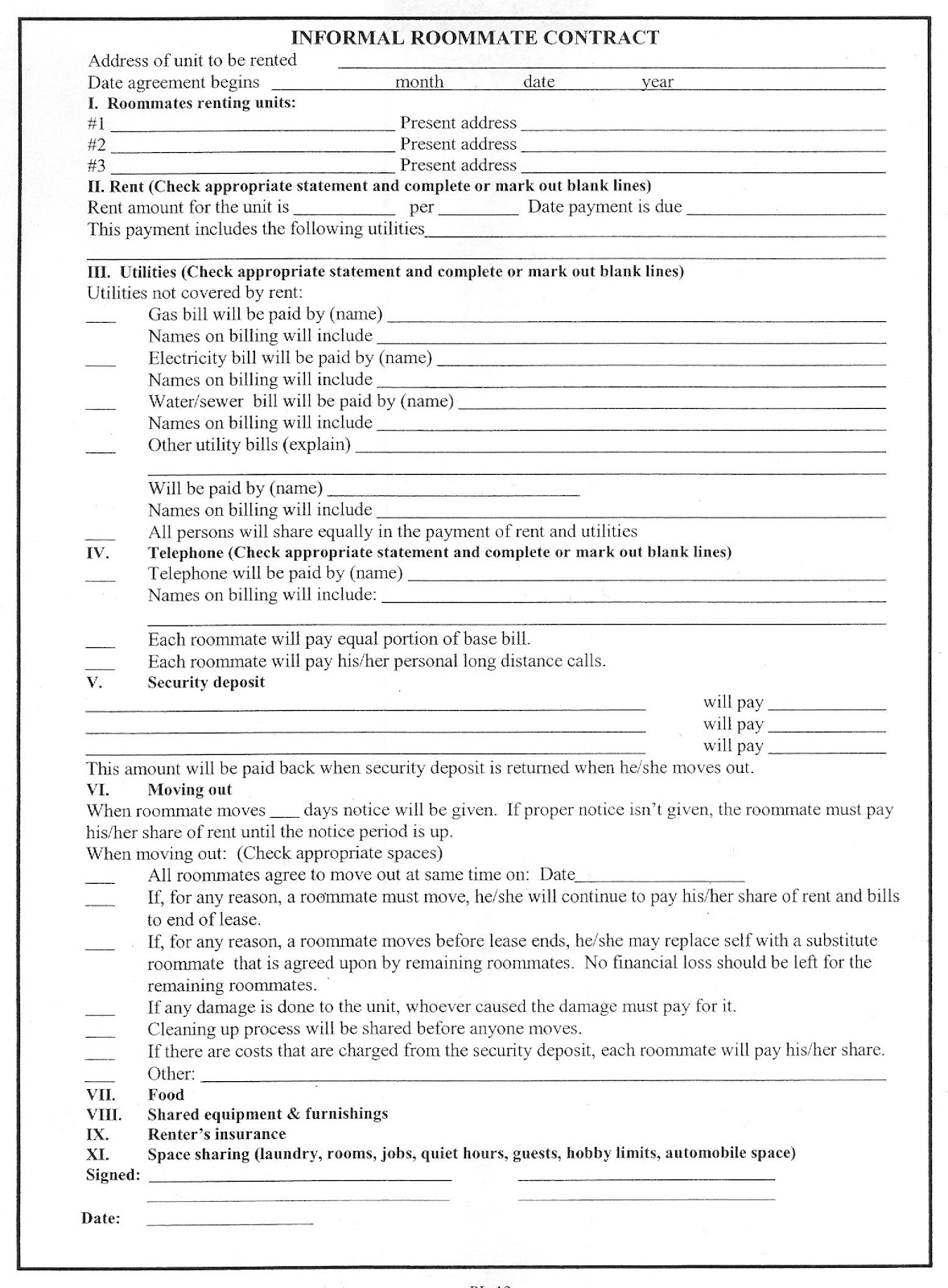
 A couple things you can do to prevent problems is to do a serious consideration of your compatibility (we will be working on a compatibility chart) and to work out an informal roommate contract. The compatibility chart will bring up issues you may not have thought about and the informal roommate contract will help to settle disputes that will undoubtedly arise during your shared housing period.
 The Roommate Compatibility Chart should include sections on personalities, sleeping habits, eating habits, housekeeping attitudes, social habits, etc.
 The Informal Roommate Contract is not legally binding -- it's more of a guide to help you resolve little problems that come up (who is paying for what, who is in charge of taking out garbage, who is responsible for dishes on a certain day, what time visitors are allowed to stay, etc.).
In this example, Leonard meets Sheldon to discuss renting the room and Sheldon gives Leonard a compatibility questionnaire. Although this is a parody, the idea was to prevent an incompatible person from becoming a roommate. This is important to do even with people you have known for many years.
Tuesday, January 7, 2014
Understanding Rental Agreements / Move-In Checklist
Today we will be looking over a sample apartment rental agreement and answering some questions about where to find specific pieces of information. Questions include:
 |
| Click to Enlarge |
- Is the gas and electricity included in the rent? Explain.
- When is the rent due?
- What is the amount of rent you will have to pay?
- What happens if you make nail holes in the walls while hanging pictures or paint the woodwork white? Explain.
- What can happen if you allow your friend to repair his motorcycle in your garage or parking space?
- Who pays the water bill?
- Who is going to clear the sidewalks and driveways during the winter?
- Will your security deposit always be returned in full? Explain.
- Can you keep a dog in the apartment?
- If you have to leave town because of a job change, can you sublet the apartment? Is it possible under any circumstances?
- If there is a hail storm and the roof is damaged, who is responsible for fixing it so it doesn't leak?
- Can your sister come into the apartment and stay indefinitely?
- Can you run a mail order business from your apartment?
- When can the landlord raise the rent?
- Under what circumstances can the rental agreement be ended by the landlord?
IF YOU DON'T UNDERSTAND ANY TERMS OF A RENTAL AGREEMENT, TAKE IT TO SOMEONE WHO WILL EXPLAIN IT TO YOU. DON'T SIGN ANYTHING YOU DON'T UNDERSTAND!
We will also look over a standard "Move-In/Move-Out Itemized Statement" from the California Apartment Association. It's the standard form that landlords go over in the move-in "walk-through" for new tenants -- and it's where prospective tenants should write down every flaw they see (dirty items, scratched floors, dented walls, nail holes, cracked glass, etc.). The same form will be used when the tenant moves out.
(Here is a similar online example of this form.)
Monday, January 6, 2014
A Modern Allegory of Hansel and Gretel
Getting Out On Your Own
 |
| Sometimes when we get out on our own we find that things are harder than we thought they were going to be. The freedom to do what we want doesn't measure up to our expectations. But for some, the promise of getting what you want whenever you want is too enticing to pass up -- so we go into debt [usually by credit cards]. |
 |
| So we get a little here... and get a little there... and we don't really pay attention to the looming financial burdens that we are facing for our future. |
 |
| Eventually the credit card industry has us so indebted to them that there is no escape. We get so deep into debt that we find it difficult to make a payment. We end up missing a payment and suddenly our 2% APR credit card becomes 18% APR. |
 |
| Because our monthly payments are even higher now, we miss another payment. This sends our APR rate through the roof to 30 or 40% because we are now a "credit risk." We find ourselves scrimping and saving just to make the monthly payments on all of our different debt balances. |
 |
| Luckily we finally figured out that debt was a bad thing and realized that the credit card companies are NOT trying to help us. We started paying off our debts (using steps like Dave Ramsey's Debt Snowball) and ended up being debt free. And we lived happily ever after. |
Moving Out on Your Own?
(Modified from http://www.selfgrowth.com)
Read the article then follow the instructions at the end:
Since most of us will be renting our first place, we will begin there. There are usually two ways to go. You can rent month-to-month, which means you are able to move out whenever you want, but it also means the landlord can kick you out or raise your rent almost at will. The other way to go is a lease. The lease locks you into a predetermined number of months. For most apartments and condos, a one-year lease is standard. Landlords will usually charge you less if you sign a lease with them. Keep in mind that if you sign a one-year-lease and decide to move out after two months, you’re still on the hook for the additional ten months. Make sure you really like living under that roof and plan to stay there for the lease period or you may want to stick with a month-to-month.
Whenever you rent an apartment or a house, there will always be a deposit required. This deposit will vary based on:
- The amount of the rent.
- Your credit score.
- Are you signing a lease or renting month-to-month?
- Is the landlord buying a new car that month?

OK, moving day.
You’ve taken ten minutes and packed up all your worldly possessions. Mom is standing by the door weeping because her baby is now ready to fly the coop. Even though you needed them to give you 20 bucks to go out last week, you are ready to be an independent adult. Dad is also standing by the door, but he’s got a slight grin on his face. Why you ask? He is planning how to turn your room into his office or new entertainment center! But forget about that for now. You’ve found the apartment, signed the rental agreement, paid your fees and are moving in. Now what?
- Have the phone turned on [unless you have your own cell phone].
- Have all the utilities turned on (gas, electric, propane, kerosine, etc.).
- Have cable activated if you’re using cable [or even have your own television].
- Move all your stuff in (which is usually a bag or two).
- Get some furniture in that place (beanbags and milk crates are popular in first apartments).
- Get some food in the fridge (make sure the place COMES with a fridge!).
- Make sure you have at least a towel or two and don’t forget the toilet paper.
- A vacuum cleaner would be nice.
- Get hooked up for Internet access (might be part of your cable or phone service).
- Get some plates and silverware and maybe a glass or two (you may get tired of paper plates and plastic silverware).

Assignment:
- Open a new document in Microsoft Word and put your name in the top-right corner.
- Title your page "Moving Out" (bold and center this)
- Write one paragraph about when you plan to move out on your own and describe how you expect to be able to do that. Will you have help? Where will you go? If you are already out on your own, discuss how it went for you and what you have learned.
- Create a section title called "Questions:" (bold this)
- Explain the following items based on your reading above:
- When would a lease be good for you?
- When would a lease be bad?
- What kinds of "deposits" might you have to pay when moving in somewhere?
- What does the term "first and last" mean in an ad for an apartment?
- How does having a pet affect your plans for moving out?
- Create a section title called "Must Haves" (bold this)
- Create a bulleted list of items that you absolutely must have when you move out
- Think about which tools you need (hammer, screwdriver, etc.)
- Which cooking supplies (frying pan, turner, etc.)
- Which appliances (microwave, mixer, vacuum, etc.)
- What do you use every day in your life? (towels, coffee cups, etc.)
- List things you wouldn't want to do without (television, furniture items, etc.)
Friday, December 20, 2013
Guest Speaker Today: DeVry

You will be receiving credit for being respectful and attentive during the presentation. If you are disruptive, ask meaningless or off-topic questions, or otherwise fail to participate, you will receive a zero for the day.
If you have suggestions or ideas for guest speakers, please let me know.
Tuesday, December 17, 2013
Careers, Finance, and Character: It's a Wonderful Life
"It's a Wonderful Life" is a movie that was released almost 60 years ago -- in 1946. It's about an angel who helps a compassionate but despairingly frustrated businessman by showing what life would have been like if he never existed.

- It's a good study of someone who has dreams of what they want to do but situations in life move them in another direction.
- It's a good example of how finance in a savings and loan situation works.
- It demonstrates a "run" on a bank.
- It does a good job of showing how our great grandparents (and great-great grandparents) weren't really so different from us. Whether we [or they] are willing to admit it or not.
- It shows how a good, intelligent, hard-working person can still suffer from depression.
- It reminds us that we don't always know the difference we are making in others' lives.
There aren't a lot of requirements for this movie other than paying attention, so I will have computers off during this time.
I have a worksheet for you to complete for the first and second halves of the movie which I will give you in class, but if you are not here and you would like another copy you can download it. (Here)
I have a worksheet for you to complete for the first and second halves of the movie which I will give you in class, but if you are not here and you would like another copy you can download it. (Here)
I'll be showing it in class, but here's an online version that you can watch:
Monday, December 16, 2013
Finish Banking Packet
Today I would like you to do the following:

- Finish all checks, deposit slips, and check registers entries
- Reconcile / balance all debits and credits.
- Check off every deposit
- Check off every check
- Check off every ATM or Debit transaction
- Make notes of any missing checks
- Make notes of any other discrepancies
- Check your final balance with someone else in the classroom -- or two people if one of your balances doesn't match
- When turning in your packet, make sure you include:
- Completed Bank Application
- All Checks
- All Deposit Slips
- All Check Registers
- Both Monthly Statements (with checked off items)
- Complaint Letter (for damaged DVD) -- if you still have it.
- Turn in your packet with your name clearly written on the front.

Friday, December 13, 2013
Continue Banking Simulation
Today we're going to finish month two of our virtual checking accounts. Follow the correct procedure for each of the following transactions, including writing checks (if applicable), writing items in the Transaction Register, etc.
- 3/22 - You have a garage sale to save up additional money to cover your upcoming summer college class. You manage to collect the following amounts which you will put on your Deposit Slip:
+ 37 quarters
+ 18 dimes
+ 12 nickels
+ 55 pennies
+ 6 $20 bills
+ 4 $10 bills
+ 7 $5 bills
+ 41 $1 bills
+ Check #1824 for $20.00
+ Check #154 for $16.50
+ Check #913 for $100.00
+ Check #8213 for $125.50 - 3/23 - You receive an Income Tax check for last years taxes. The check (#52280226) is for $473.29. Fill out a Deposit Slip for this check and indicate that you would like $100 cash back which you will use to go out with some friends. Make sure to put this in your Check Register.
- 3/24 - You stop by Games R' Us to buy a new video game. Write a check for $80.29.
- 3/25 - You decide you need a new hat. Use your debit card to buy your hat from Wig Out for $22.95.
- 3/25 - You need a new shirt to match your cool new hat. Write a check for $24.17 at Cold Topic.
- 3/25 - You buy a belt, socks, and underwear at American Dog. Write a check for $33.91.
- 3/26 - You and your friends go to dinner and the movies. You use your cash to pay $11.12 at McTaco King. You also use your cash to pay $8 to get in to the movies and $8 for popcorn at Stadium 6 Theater.
- 3/27 - You want to go clubbing this weekend so you need to fill up your car with gas. Spend $42.11 on gas at Tweakin' Beacon on your debit card.
- 3/28 - You drive to Sacramento and pay the $10 cover charge at Yo'Mamaz with cash. You use your debit card to buy soda's amounting to $24. They also charged $2 to use your debit card.
- 3/29 - Your friend is arrested for being in a bar fight. Write a check for $250 to bail them out. Make the check payable to The Sacramento Police.
- 3/30 - You're really tired the next morning and decide you need some coffee. Stop by MoonBucks and use your debit card for $11.54.
When you have finished, compare your last amount with your neighbor and try to figure out who's wrong. :)
Thursday, December 12, 2013
Problem With a Product
You sit down to watch the movie you purchased on February 27th and realize the it's broken. You try to call the store but they say they can't do anything over the phone. They suggest you speak to Mike Jackson, the manager. Rather than try to call back on a day that he is at work, you decide to write a more official complaint letter. Looking up the address, you see that the video store is located at 518 South School Street, Kelseyville, CA 95451.
Below is a template for a complaint letter that you can use as a reference. Remember that everything in the page lines up on the left, and you always begin with YOUR name and address.
Save a completed copy of your later to your Thawspace as "Complaint Letter".

Below is a template for a complaint letter that you can use as a reference. Remember that everything in the page lines up on the left, and you always begin with YOUR name and address.
Save a completed copy of your later to your Thawspace as "Complaint Letter".

Wednesday, December 11, 2013
Begin Second Month's Transactions
Today we're going to begin working on month two of our virtual checking accounts. Follow the correct procedure for each of the following transactions, including writing checks (if applicable), writing items in the Transaction Register, etc.
- 3/03 - Looks like it's time to hit the grocery store again. You go to Super Mega Mart to stock up on some necessities because buying in bulk will help you save money. Write a check for $227.32 to Purity Market.
- 3/05 - You receive your Netmoviez bill in the mail. Send a check for $10.14 to cover it.
- 3/10 - You receive your cell phone bill in the mail. Write a check for $47.52 to American Cellular.
- 3/14 - Your electric bill has arrived. Write a check for $88.14 to Kelseyville Electric Company.
- 3/15 - You receive your paycheck today. Complete a deposit slip and log it in your Register.
- 3/16 - You have some engine trouble with your car. After the mechanic looks at it, you discover it's going to be $316.77 to replace your water pump and radiator hose. Write a check to Kelseyville Car Repair.
- 3/17 - You sill want to put away some money for emergencies, but you can only afford $50 this month. You stop in at the bank and have the teller move $50 from Checking to Savings. Remember to remove the money from Checking in your Register.
- 3/18 - You need to drop by the grocery store to pick up a few things. Write a check to Purity Market for $23.22.
- 3/19 - It's time to pay your car insurance again. Go online to the Chameleon Insurance web site and submit your electronic payment for $118.33.
- 3/19 - You realize you're gas tank is just about on empty. Use your Debit Card to buy $54.32 in gasoline at Filler Up Gas & Go.
- 3/21 - You stop at Restored Treasures, a second-hand shop that sells furniture, and buy a couch for $100. With tax, the total price comes to $109.75. Write a check.
Reconcile Bank Statement / Balance Checkbook (Month 1)
Today we will be balancing (or "reconciling") our first month's transactions. Approximately once a month you will receive a "bank statement" which shows all debits (checks, ATM withdrawals, automatic deductions, debit charges, transfers, etc.) and credits (deposits or transfers to checking). Your bank statement also shows check numbers, dates the transactions were made, daily balances, bank fees, etc.
There is a copy of your bank statement in the back of your packet. You should have a statement for last month (the one we need today) and one for this month (which we will use in a few days).
Begin going through your check register and comparing the items against the bank statement. If the items match (check number, amount, etc.) put a check mart next to the item on your bank statement and a check mark in the "check mark column" next to the item of your check register.
Repeat these steps going through deposits/credits.
Next, figure out what has not been taken out of [or put into] your bank account. Circle them so you can make sure they clear by next months statement. Do your accounts balance?
There is a copy of your bank statement in the back of your packet. You should have a statement for last month (the one we need today) and one for this month (which we will use in a few days).
Begin going through your check register and comparing the items against the bank statement. If the items match (check number, amount, etc.) put a check mart next to the item on your bank statement and a check mark in the "check mark column" next to the item of your check register.
Repeat these steps going through deposits/credits.
Next, figure out what has not been taken out of [or put into] your bank account. Circle them so you can make sure they clear by next months statement. Do your accounts balance?
Tuesday, December 10, 2013
Begin Checking
Today we're going to begin working on our virtual checking accounts. Get your envelopes out and get ready to begin your first months transactions.
Follow the correct procedure for each of the following transactions, including writing checks (if applicable), writing items in the Transaction Register, etc.
Follow the correct procedure for each of the following transactions, including writing checks (if applicable), writing items in the Transaction Register, etc.
- 2/01 - You take a trip to Curl Up & Dye -- a little beauty parlor and barber shop in downtown Kelseyville. The cost to do your hair (including tax and tip) was $32. Write a check.
- 2/01 - You receive your first paycheck from Griffith Enterprises which you deposit into your checking account. Complete a deposit slip and enter the amount in your Register.
- 2/02 - You decide that you need a new pair of shoes for all of the standing and walking you will be doing. You drop by G-Mart and find a nice pair of shoes. Rather than write a check you decide to use your Debit Card for the $52.79 total.
- 2/03 - You go to lunch with a few of your colleagues at McTaco King. Use your Debit Card to pay the $6.42 total.
- 2/04 - Rent is due on the 1st of the month, but it's not late until the 5th. Write a check for $600 to cover February rent, payable to Shady Acres Apartments.
- 2/06 - The cupboards are looking a little bare and you have a friend coming over for dinner. You go to the grocery store to stock up on some necessities. Write a check for $184.69 to Purity Market.
- 2/07 - You receive your Netmoviez bill in the mail. Write a check for $10.14 to cover it.
- 2/11 - You receive your cell phone bill in the mail. Although money is running a little low, write a check for $34.71 to American Cellular.
- 2/15 - Thankfully you receive your paycheck today. Complete a deposit slip and log it in your Register.
- 2/17 - Your electric bill came in. Write a check for $74.61 to Kelseyville Electric Company.
- 2/19 - You're in need of some more groceries. You drop by Purity Market and spend $32.17. Write a check.
- 2/22 - You decide to put away some money for emergencies. You stop in at the bank and open a Savings account by depositing $250. Remember to remove the money from Checking in your Register.
- 2/23 - You decide to do some decorating in your apartment. You stop by G-Mart and buy some wall hangings, dishes, and a house plant. Write a check for $59.90.
- 2/24 - It's time to pay your car insurance. Go online to the Chameleon Insurance web site and submit your electronic payment for $118.32.
- 2/25 - You stop on the way to work to get gas. Use your Debit Card to buy $41.17 in gasoline.
- 2/26 - You and some friends decide to go to Rock & Bowl at Mega Bowling Alley. Rather than drive back to your regular bank, you stop at an ATM at another bank and withdraw $40 from your checking account. The bank charges you $2 for this service.
- 2/27 - You have a movie reserved at The FlixBuster. Write a check for $21.55.
- 2/27 - When you arrive at FlixBuster you discover that they don't take checks. VOID the check you wrote to FlixBuster and use your Debit Card instead.
- 2/28 - The Wilderness Girls dropped by selling cookies. You buy three boxes of Minty Goodness at $4.00 per box. Write a check to cover the cost.
- 2/29 - It's time to pay your monthly Internet bill. Write a check to InterWebz for $39.49. While you are there dropping off your payment, the company offers you a discount if you have Automatic Withdrawal from your checking account. VOID the next check to leave with them and next month you will receive $5 off your bill.
- 2/29 - You stop at the SuperQuickyMart to pick up a gallon of milk. Use your debit card for the amount of $3.41.
- 3/1 - You receive another paycheck. Deposit it into your checking account. Make sure you fill out a Deposit Slip to go with it, then log it in your Check Register.
- 3/2 - Your good friend has asked to move in with you. You decide that it would really help with the cost of the rent, so you get permission from the landlord. Your friend gives you a check for $300 for their half of the rent and you write a check for $300 for your half of the rent. Both checks are made payable to Shady Acres Apartments and cover rent for April.
Monday, December 9, 2013
Begin Banking Simulation
You recently graduated from Kelseyville High School and got hired at Griffith Enterprises in Kelseyville, California as an office assistant producing educational videos and multimedia. Griffith Enterprises is located at 5480 Main Street, Kelseyville, CA 95451 and the phone number is (707) 279-1234.
Your beginning salary is $2000 per month and you will be paid on the 1st and the 15th of each month. You will receive your pay in the form of a voucher check which is typically divided with perforations in two parts -- one part being the actual check (the Net Amount of your pay) and the other part being the voucher (or record) of how your pay was calculated. You typically Deposit the check portion into your bank account and file the voucher away for your records.
In discussing your salary with your new employer, you have learned that the following items will be deducted from your paycheck:
Your beginning salary is $2000 per month and you will be paid on the 1st and the 15th of each month. You will receive your pay in the form of a voucher check which is typically divided with perforations in two parts -- one part being the actual check (the Net Amount of your pay) and the other part being the voucher (or record) of how your pay was calculated. You typically Deposit the check portion into your bank account and file the voucher away for your records.
In discussing your salary with your new employer, you have learned that the following items will be deducted from your paycheck:
- Federal Income Tax: Approximately 15% of your income goes to Federal Income Tax. This can be less or more depending on your situation. For example, if you are single and make less than $8,500 in a year you may only have to pay 10%... but if you make over $34,500 you may be paying 25-35%. (And depending on your deductions and credits, you may get some [or all] of that money back in an income tax refund at the beginning of the next year.)
- State Income Tax: Current Estimates are that California Income Tax is equal to about 9.9%.
- Social Security: Currently we are paying approximately 4.2% of our pay toward Social Security; a program provided by the Federal Government that includes old age and survivors' insurance, old age assistance, and unemployment protection. This is sometimes listed as FICA (Federal Insurance Contribution Act) on a voucher [or pay stub].
- Medicare: Currently charged at 1.45%, Medicare is used to cover medical costs for older people.
- Medical/Dental: Because you are a new employee, you are not yet eligible to receive medical or dental insurance. Once you are eligible you will be asked to select from plan options.
- ACCT #: (leave blank for now)
- Required Signatures: 1
- Account Type: Free Checking
- SSN: (use 123-45-6789)
- Title: Your own full name
- Business or Occupation: Multimedia Production Assistant
- ATM or Debit Card? Yes
- Internet Banking? Yes
- Previous Bank: Clear Lake Savings & Loan: 101 Lakeview Drive, Clearlake, California 95422
- Previous Acct. #: 8675309
- Amount of Deposit: $226.68 (Description: Transfer)
- Type of Personalized Checks: Regular Free
- No., Style, Color, and Cover: (leave blank)
- Starting Number: 101
Because we are starting over with a new bank, we will also begin a new Check Register. Fill out the front of your check register with your information. We are bringing $226.68 from our previous bank into our new bank, so open the check register and enter that amount in the "Beginning Balance" spot.
One method of keeping track of items in your checkbook is to use one line per transaction. For our simulation, we will be using two lines per transaction -- the actual transaction on the first line and the balance and additional information on the second (usually shaded) line.
One method of keeping track of items in your checkbook is to use one line per transaction. For our simulation, we will be using two lines per transaction -- the actual transaction on the first line and the balance and additional information on the second (usually shaded) line.
Thursday, December 5, 2013
Stokes Tourney / Finish Missing Work
Today and tomorrow are going to be a bit hectic because of the Stokes Tourney. I'd like to use these two days to complete any missing assignments. Beginning Monday, December 9th I will only accept projects from after that date.
Remember that we have two more weeks and then Winter Break.
Wednesday, December 4, 2013
Guest Speaker: The Art Institutes

 As always, I expect respect, attention, and valid, appropriate questions for our guest speakers.
Tuesday, December 3, 2013
Credit Card Research Project
 Today we are going to be comparing three different credit offers. I will provide you with two and your homework is to find a 3rd.
- I will pass out a Credit Card Comparison worksheet [you can download one Here if you need one at a later date].
- Fill in the blanks for your 3 different credit offers.
- Turn in your results page.
Credit Card Offers:
Next I want you to look at this offer I got in the mail in 2010. It is not edited to make it look worse -- this is how it came. It's in a folder pamphlet form (which I will show everybody tomorrow) but I scanned both sides so you could see the details. You can click the picture to read the small print:

ADDITIONAL HOMEWORK: Interview one adult who has [or has had] credit cards using the provided worksheet.
Monday, December 2, 2013
Beginning Checking: Checks and Registers
Today we're going to begin a unit on using a checking account. First we'll do a math worksheet going over percentages, decimals, and writing amounts out in longhand. (I will be handing out a copy in class, but you can get a copy here)
Next we will explore the general layout of a personal check:

Finally we will do a quick simulation of writing checks and using a check register. I will be passing out a worksheet with three checks and a register (you can view a copy here: Checks with Register). Use the following scenario to complete your worksheet:
Next we will explore the general layout of a personal check:
Finally we will do a quick simulation of writing checks and using a check register. I will be passing out a worksheet with three checks and a register (you can view a copy here: Checks with Register). Use the following scenario to complete your worksheet:
- You begin your checking account today (12/02/13) with $135.72 from your piggy bank.
- You receive a Check for $550.00 from your work and Deposit it to your checking account on 12/03/13.
- Write a Check for your rent on 12/04/13 for $525 to Kelseyville Green Apartments.
- You go to dinner at Lyndall's on Saturday Night (12/05/13) for $18.27 and use your Debit Card.
- You send a Check to Edward Teach in the amount of $31.19 on 12/06/13 for a movie you bought on eBay.
- You receive a Check for $550.00 on 12/07/13 from your work and you Deposit it to your checking account that afternoon.
- You write a Check for your car payment to Airport Auto Brokers on 12/08/13 in the amount of $224.72.
- You use Online Banking to pay $124.25 for your PG&E bill on 12/09/13.

Compare your ending balance with a neighbors to verify your accuracy.
Here are a couple video clips to explore:
Friday, November 22, 2013
Debt: Debunking the Myths (Parts 1-7)
Answer the following questions you watch the videos by Dave Ramsey on the myths about Debt:
Note: Don't print until we complete the "Myths" section.
Myth 1
Note: Don't print until we complete the "Myths" section.
Myth 1
- Myth: If I ____________ money to a friend or relative, I will be helping them.
- Truth: The relationship will be strained or ________ .
Myth 2
- Myth: By ______________ a loan, I am helping out a friend or relative.
- Truth: The bank requires a cosigner because the person isn't likely to ___________. Be ready to pay the loan and have your credit damaged.
Myth 3
- Myth: ___________ ____________, rent-to-own, title pawning, and tote-the-note lots are needed _______________ for lower income people to help them get ahead.
- Truth: These are horrible, greedy rip-offs that aren't needed and benefit no one but the owners of these companies.
Myth 4
- Myth: The ___________ and other forms of gambling will make me ____________.
- Truth: The lottery is a _______ on the poor and on the people who can't do math.
Note: Texas Tech University did a study on the Texas Lottery and found that people without a high school diploma spent an average of _________ a month playing the lottery. College graduates spent _________ a month on average. When studies are done on the lottery, it's always the lower-income ZIP codes that generate the highest revenue on sales.
Myth 5:
- Myth: ____________ payments are a way of life and you'll always have one.
- Truth: Staying away from car payments by driving reliable used cars is what the typical ____________ does. That is how they became millionaires.
Myth 6:
- Myth: ____________ your car is what sophisticated financial people do. You should always lease things that go down in value. There are tax advantages.
- Truth: Consumer Reports, Smart Money magazine and a good calculator will tell you that the car _______ is the most ________ way to finance and operate a vehicle.
Myth 7:
- Myth: You can get a good deal on a _____________ car.
- Truth: A new car loses _________ of its value in the first four years. This is the largest purchase most consumers make that goes down in value.
On average, a $28,000 car will be worth $8,400 in four years.Myth 8:
- Myth: I'll take out a 30-year mortgage and pay ______________.
- Truth: Life happens and something else will always seem more important. Never take out more than a _________ year fixed-rate mortgage.
Myth 9:
- Myth: It's wise to take out an ________ or a ___________ mortgage if "I know I'll be moving."
- Truth: You will be moving when they _______________.
The adjustable-rate mortgage is here to keep the _____________ from losing money. It transfers the ____________ of higher interest rates to you.
Myth 10:
- Myth: You need a __________ __________ to rent a car or make ____________ online or by phone.
- Truth: A __________ card does all of that.
Myth 11:
- Myth: I pay my __________ _______ off every month with no annual payment or fee. I get brownie points, air miles and a free hat.
- Truth: When you use cash instead of plastic, you spend ___________ less because spending cash hurts.
According to carddata.com, U.S. consumers racked up an estimated $51 billion worth of fast food on their personal credit and debit cards in 2006, compared to $33.2 billion one year ago.
Myth 12:
- Myth: I'll make sure my ___________ gets a credit card so he or she can learn to be responsible with money.
- Truth: Teens are a huge ___________ of credit card companies today.
As soon as you get to college, you will receive offers from credit card companies. About 80% of college graduates have credit card debt before they even get a job.
Myth 13:
- Myth: The home equity loan is good for __________ and is a substitute for the emergency fund.
- Truth: You don't go into ____________ for emergencies.
Myth 14:
- Myth: Debt _____________ saves interest and you get a smaller ________________.
- Truth: Debt consolidation is a _______________.
Debt consolidation saves little or no _______________ because you will throw your low interest loans into the deal.
You cannot ____________ your way out of debt! _____________ payments equal more _________ in debt.
Myth 15:
- Myth: Debt is a _________________. It should be used to create prosperity.
- Truth: The _______________ is slave to the lender.
When surveyed, the Forbes 400 were asked, "What is the most important key to building wealth?" _____________ replied that becoming and staying ________ free was the number one key to wealth building.
Thursday, November 21, 2013
The Dangers of Debt
 This time of year is notorious for the growth of personal debt -- mostly due to purchasing Christmas presents with credit cards. Today we will be starting Dave Ramsey's video series on the Dangers of Debt.
Before we begin, answer the following questions:
- In what ways is it easier, safer, or more convenient to use a credit card instead of cash?
- What kinds of "rewards" do credit card companies offer customers for using their cards?
- Why is it important to "Build your credit?"
- Why are teenagers the number one target of credit card companies?
During [or after] the video, answer the following questions:
- About how many credit card applications does the average college student receive their first year of college?
- What does "living paycheck to paycheck" mean? (70% of Americans are doing it)
- What is a "paradigm shift"?
- How has the perception of debt changed since the early 1900's? (Beginning with the 1910 Sears Catalog example) How do our great grandparents, grandparents, and parents see debt differently?
- How did credit cards begin in the 1950's?
- Approximately how many credit card offers went out last year? (According to this movie from a few years ago)
pred·a·tor
/ˈpredətər/Noun
- An animal that naturally preys on others.
- A rapacious, exploitative person or group.
Wednesday, November 20, 2013
Maxed Out: Finishing Up
Today we will be finishing up the Maxed Out video and questions. Next we will briefly discuss the ramifications of credit cards before beginning the next part of the assignment today.
Tuesday, November 19, 2013
Continue "Maxed Out" Clips & Discussion

The Washington Post called this documentary "a matter of life and debt" and sent on to say, "This swift-moving documentary is something all American high school graduates should watch... especially before they head to college and are asked to sign up for credit cards."
The segments we watched this week discussed how the lending industry "sells debt" to companies who go after those who owe them money. It also covers the tragedy that can happen when people get so deep into debt that they can't see a way out.
In Microsoft Word, answer the following questions (Don't print when finished because we will continue with this tomorrow):
- What tactics do debt collectors use get people to pay?
- Why do debt collectors push people so hard?
- Why do some people resort to pawn shops?
- Who funds the largest check cashing chain in the U.S.?
- Do you think lenders are partially responsible for America's debt crisis? How so?
- Why does your credit card company want you to be late on your payments?
- Why do credit card companies want customers who have filed bankruptcy?
- Why do credit card companies want 18 year old college students?
- Why don't Senators and Congressmen punish credit card companies for "predatory lending"?
- Discuss your right to privacy from individuals, corporations, and the Government.
About the Movie: Answer these on the same page as the previous 10 questions
- What is your opinion of the movie?
- Is it worth showing to students next year?
- In what ways did the movie change the way in which you look at money?
Monday, November 18, 2013
Maxed Out

Today we will begin watching part of an award-winning documentary called, "Maxed Out". We will be pausing the movie every few minutes to discuss various aspects of the movie as they relate to this class, our experiences, and our future. Please feel free to comment, ask questions, or ask for clarification.
You can rent this movie at local movie stores or, if you have Netflix Streaming at home, you can view it at: http://movies.netflix.com/WiMovie/Maxed_Out/70058892?trkid=496624
An interesting juxtaposition from the opening scene in Maxed Out is this video about the economic collapse of Las Vegas and the drying up of the housing market there.
Friday, November 15, 2013
Guest Speaker: Rihannah Mitchell (WestAmerica Bank)
 Today we have a guest speaker (Rihannah Mitchell) from WestAmerica Bank. I expect everybody to pay attention, ask relevant questions, and be respectful.
The WestAmerica web site is at: https://www.westamerica.com/
Thursday, November 14, 2013
Budget: Creating an Excel Spreadsheet
If you're having trouble understanding the coordinates in Excel, try to think of them like a Battleship game:


 |
| Rows are horizontal... like the rows of a theater. And they are numbered -- row 3, row 4, etc. |
 |
| Columns are vertical... like columns in a building. They are lettered -- column A, B, C, etc. |
- When you open it, go to FILE > MAKE A COPY and save it to your folder to work on.
Subscribe to:
Posts (Atom)